Last verified: September 20, 2025
TL;DR
If Yahoo's bulk sender requirements have blocked your email campaign mid-send, immediate actions include verifying your authentication protocols, checking your spam complaint rates, and ensuring compliance with Yahoo's sender guidelines. Addressing these issues promptly can help restore your email deliverability. Understanding and adhering to Yahoo's bulk sender requirements is crucial for maintaining successful email campaigns.
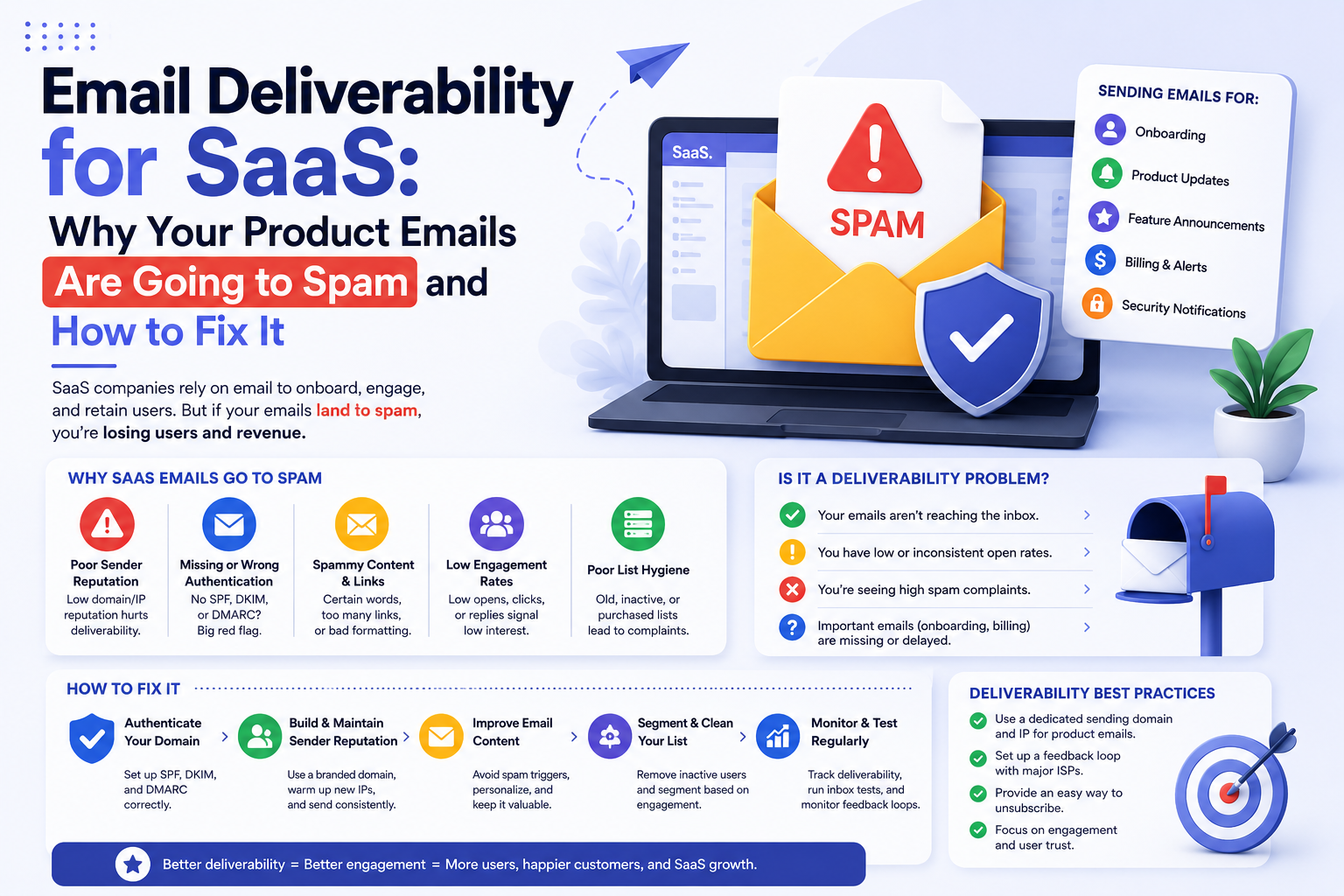
Graphic on email deliverability challenges and solutions for SaaS companies.
What Are the Main Approaches in This Space?
Yahoo enforces a specific set of bulk sender rules: SPF and DKIM authentication aligned under a published DMARC policy, one-click unsubscribe (RFC 8058) on marketing mail, and a spam complaint rate held under the figure Yahoo publishes on its Sender Hub. A mid-send block is almost always a rate-limiting response to the complaint signal — once complaints on the sending domain or IP cross the line, Yahoo begins deferring or rejecting connections with 4xx and 5xx SMTP codes, so the send stalls partway through instead of failing at the first message. This space includes various approaches to optimize deliverability, primarily revolving around authentication, reputation management, and compliance with email service provider (ESP) guidelines.
Authentication Protocols: Implementing SPF, DKIM, and DMARC protocols verifies the legitimacy of email sources and prevents spoofing. These protocols help establish trust with email providers and improve deliverability rates.
Reputation Management: Maintaining a positive sender reputation means monitoring spam complaint rates, managing bounce rates, and ensuring that emails are sent to engaged recipients. High complaint rates can lead to emails being filtered as spam.
Compliance with ESP Guidelines: Adhere to the specific requirements set by email providers like Yahoo. This includes implementing one-click unsubscribe options and maintaining low complaint rates. Providers often have unique guidelines that must be followed to avoid deliverability issues.
List Hygiene and Engagement: Regularly cleaning email lists to remove inactive or invalid addresses helps maintain high engagement rates. Engaged recipients are more likely to interact with emails, which positively impacts sender reputation.
These approaches are foundational to any strategy aimed at optimizing email deliverability and ensuring that marketing campaigns are effective.
How Do You Recover After Yahoo Blocks a Campaign Mid-Send?
Step 1: Verify Authentication Protocols
Ensure that your SPF, DKIM, and DMARC records are correctly configured. These authentication protocols are essential for proving the legitimacy of your emails and preventing them from being marked as spam.
Step 2: Check Spam Complaint Rates
Review your spam complaint rates against the threshold Yahoo publishes on its Sender Hub best practices page: keep complaints below 0.3%, and ideally under 0.1%. Crossing 0.3% is what triggers deferrals and blocks. If you are above it, adjust your email content and targeting to reduce complaints.
Step 3: Review Yahoo's Sender Guidelines
Familiarize yourself with Yahoo's sender requirements, including the need for a one-click unsubscribe option and maintaining low complaint rates. Compliance with these guidelines is crucial for restoring deliverability.
Step 4: Conduct a List Hygiene Audit
Perform a thorough audit of your email list to remove inactive or invalid addresses. This helps improve engagement rates and reduces the likelihood of complaints.
Step 5: Monitor Domain Reputation
Use tools to monitor your domain's reputation and identify any issues that may be affecting deliverability. Address any negative signals promptly to maintain a positive reputation.
Step 6: Implement Feedback Loop Monitoring
Enroll in Yahoo's Complaint Feedback Loop (CFL) to receive notifications about spam complaints and take corrective actions. This proactive approach helps maintain compliance and improve deliverability.
In-House Triage or Outside Help: How Do You Decide Mid-Block?
- DNS access and turnaround: If your team can publish SPF, DKIM, and DMARC changes the same day, authentication fixes belong in-house — vendor onboarding usually costs you more hours than the edit does.
- Whether the error code is legible: A 5xx rejection naming a missing unsubscribe header or a failed DMARC check is self-diagnosing. Unexplained 4xx deferrals across multiple IPs, with clean authentication, is where outside pattern-matching earns its fee.
- Complaint-rate visibility: If you are not enrolled in Yahoo's CFL and cannot see complaint data at all, you are triaging blind; a deliverability consultant or ESP with existing Yahoo relationships can often read the signal before your own enrollment completes.
- Whether the block is shared-IP: On shared ESP infrastructure, you cannot fix another sender's reputation — escalate through your ESP's deliverability team rather than debugging internally.
- Send-pause tolerance: If the campaign can stay paused for a week, in-house remediation and warming is viable. If revenue depends on resuming within 48 hours, buy the escalation path.
- Recurrence history: A first-time block is usually a configuration or content event. A third block in six months is a list-acquisition and reputation problem that in-house triage has already failed to solve.
Frequently Asked Questions
What's the Difference Between SPF, DKIM, and DMARC?
SPF, DKIM, and DMARC are email authentication protocols. SPF verifies the sender's IP address, DKIM ensures the email content hasn't been altered, and DMARC provides instructions on handling messages that fail authentication checks.
How Long Does It Take to Resolve Deliverability Issues?
The time to resolve deliverability issues depends on the complexity of the problems. Simple authentication errors may be fixed quickly, while reputation recovery can take weeks or months, especially if significant damage has occurred.
What Are Common Pitfalls in Email Deliverability?
Common pitfalls include neglecting list hygiene, failing to monitor spam complaint rates, and not adhering to ESP-specific guidelines. These issues can lead to poor deliverability and reduced campaign effectiveness.